You did CHF 4,000 in delivery sales last month. Before celebrating, take a look at the platform's invoice. Between the commission, payment fees and co-financed promotions, part of that revenue never reached your till. For many Swiss restaurants, delivery through platforms generates volume without improving profitability.
This article breaks down, with figures, what Uber Eats and Just Eat actually cost your restaurant in Switzerland, then lays out the options for taking back control — without necessarily leaving them altogether.
How Much the Platforms Really Keep in Switzerland
In Switzerland, according to public broadcaster RTS, the commission taken by the major delivery platforms (Uber Eats, Eat.ch — now Just Eat) generally sits between 30 and 40 % of each order's price, close to a third of every sale.
The exact rate depends on one central factor: who delivers?
- You deliver yourself (your scooters, your team): the commission drops to around 10 to 15 %. The platform only provides visibility and payment.
- The platform delivers (its couriers): the commission rises to 25 to 30 %, sometimes more, because it handles the full logistics — and passes that cost on to you. Here's the order of magnitude, platform by platform, in Switzerland:
| Platform | You deliver | Their couriers |
|---|---|---|
| Just Eat (ex-Eat.ch) | ~10–15 % | ~25–30 % |
| Uber Eats | ~15 % | ~20 to 30 % depending on the plan |
And those are just the commissions. Add to that the payment processing fees (around 1.8 % on top), the activation fees at signup, and the cost of promotions.
Why 30 % Doesn't Mean 30 %
This is the point many restaurants discover only on their first detailed invoice. Three mechanisms push the real cost well beyond the headline rate.
The calculation base. The commission isn't always applied to what you receive net of tax, but often to the subtotal paid by the customer, VAT included. As a result, the actual percentage you bear is higher than it appears.
Co-financed promotions. The "20 % off" or "free delivery" offers that drive sales? Part of that comes out of your pocket, on top of the commission.
The introductory rate. At signup, you're sometimes offered a reduced commission, even 0 %, for a few weeks. Then the full rate kicks in. Many only discover the real cost on their third monthly statement.
What It Actually Means for Your Margin
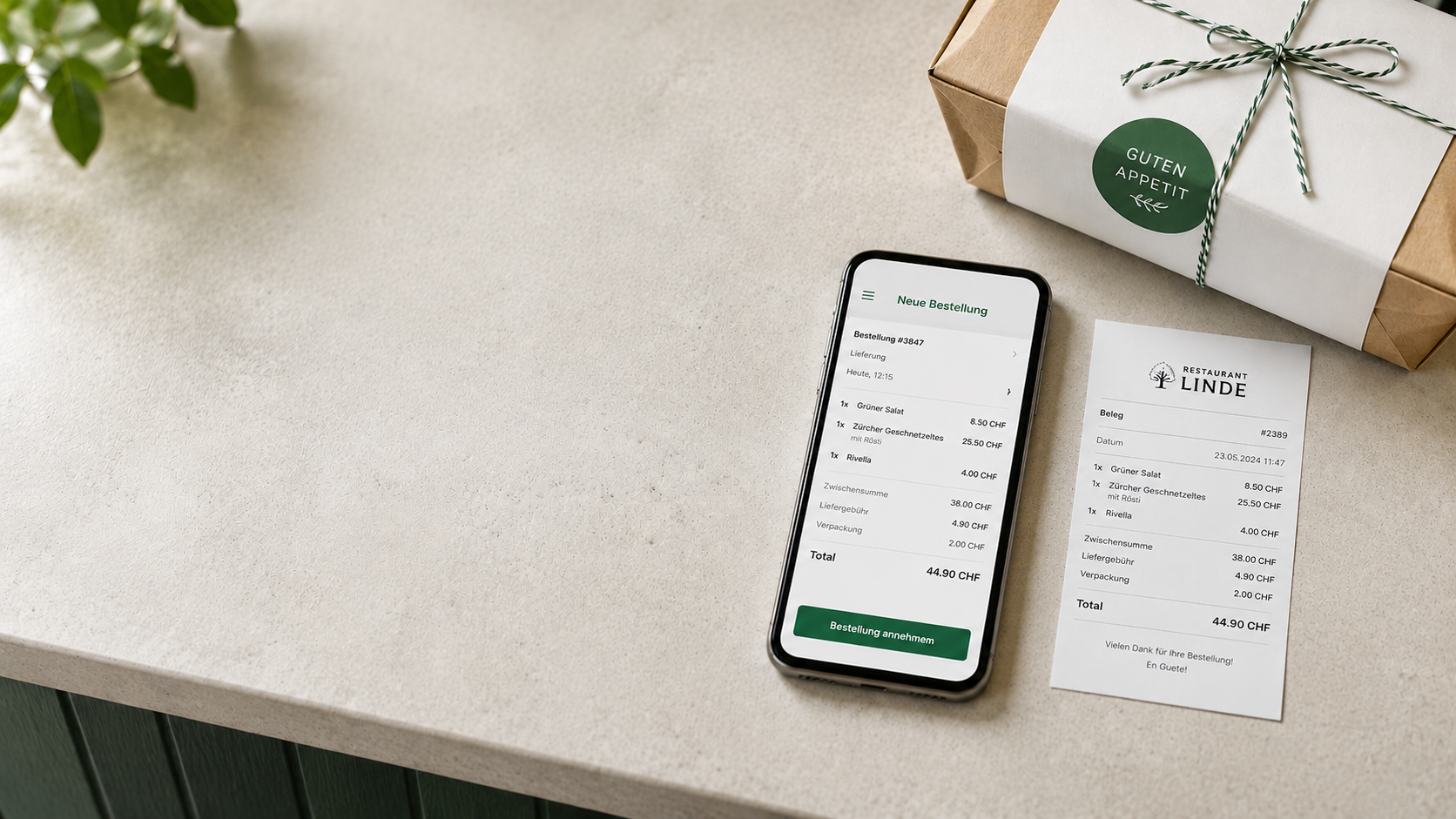
Take a CHF 40 order at a 30 % commission.
- Platform commission: CHF 12
- Food cost (~30 %): CHF 12
- Left before wages, rent, overheads: CHF 16 Out of that CHF 16, you still have to pay the person cooking, the packaging, the rent and the electricity. The net margin shrinks — and on smaller baskets, it can turn negative. That's exactly what a Lausanne restaurateur described to RTS: in a partnership with these platforms, you have to forget about profitability.
On a monthly scale: a restaurant doing 300 orders at CHF 40 on a platform charging 30 % pays CHF 3,600 in commission per month, or CHF 43,200 per year — an amount that, depending on the establishment, can equal a full-time position.
The Underlying Logic: the "Service Third" You Give Away
The platforms long put forward this justification: in the restaurant business, a dish's price splits into three — a third for ingredients, a third for overheads, a third for table service. The platform would take that service third, since there's no table service with delivery.
The reasoning has a limit: that third, you could keep it. In the dining room, the service is you. With delivery through a platform, that third goes to an intermediary — for a customer whose name, email and habits you often don't know. You're funding access to a clientele that stays the platform's.
The 3 Ways to Take Back Control
There are three levers, from the simplest to the most structural.
- Raise your delivery prices. Many restaurants charge 15 to 25 % more on platforms than at the counter, to recover part of the commission. Effective, but limited: too big a gap and the customer leaves.
- Switch to your own delivery. By delivering yourself, you bring the commission down to around 15 %. You gain on the rate, but you take on the logistics.
- Build your own commission-free ordering channel. This is the most durable lever: your regular customers order directly, you no longer pay a percentage, and you keep the customer data. It's this third lever that has the greatest effect over the long term. Let's look at how it works.
Direct Ordering, Commission-Free: ZipZest
ZipZest is a Swiss online ordering platform designed, developed and hosted in Neuchâtel since 2024. Its model differs from that of the delivery platforms on one central point: no commission on your sales.
0 Commission, a Fixed Subscription
You don't pay a percentage, but a fixed, transparent monthly subscription from CHF 79 per month. The rest of every order stays with you. Back to our example: CHF 3,600 in monthly commission becomes a CHF 79 subscription. The difference stays in your till. Over a year, a restaurant can save up to CHF 13'000 compared to traditional ordering and delivery services.
For transparency, since that's the spirit of this article: there remain the payment providers' fees (TWINT, cards), in the range of 1.9 to 2.9 % depending on the method chosen. But those fees exist everywhere, platforms included — and ZipZest itself takes nothing on top.
Your Menu Imported in 1 Click
A common obstacle — "I don't have time to recreate everything" — is limited here. ZipZest automatically imports your menu from Just Eat or GloriaFood: dishes, options, delivery zones, customers. Setup takes a few minutes.
Your Zones, Your Payments, Your Data — in Switzerland
You define your delivery zones by polygon or postal code, with fees and a minimum order amount per zone. You collect payment via TWINT (no ZipZest surcharge), cards, Apple Pay and Google Pay. And your data stays hosted in Switzerland, with support in English. All managed from a single interface: kitchen display screen (KDS), multi-printer printing, sales reports, VAT, customer reviews.
Should You Really Leave Uber Eats and Just Eat?
Not necessarily. The major platforms have one real strength: visibility. They get you discovered by customers who didn't know you. Cutting them off overnight means giving up an acquisition channel.
The most balanced approach isn't "all or nothing", but the combination:
- Keep the platforms as a shop window to attract new customers.
- Steer your regular customers toward your commission-free direct channel. A customer who has ordered from you several times no longer needs Uber Eats to find you. Every order placed through your own channel saves you the corresponding commission. That way, you gradually grow the share of your clientele that orders directly.
Platforms vs Direct Channel: the Comparison
| Criterion | Platforms (Uber Eats, Just Eat) | Direct channel (ZipZest) |
|---|---|---|
| Cost per order | 15 to 40 % commission | 0 % commission |
| Pricing model | Variable percentage | Fixed subscription from CHF 79/month |
| Customer data | Belongs to the platform | Belongs to you (CRM included) |
| Visibility / acquisition | Strong | You build it yourself |
| TWINT payment | Depends on platform | ✅ No ZipZest surcharge |
| Data hosting | Outside Switzerland | 🇨🇭 In Switzerland |
| Best for | Getting discovered | Retention without commission |
Frequently Asked Questions
How much does Uber Eats take from a restaurant in Switzerland? Around 15 % if you deliver yourself, and 20 to 30 % if Uber Eats provides the couriers, depending on the plan. Payment fees (~1.8 %) come on top.
What is Just Eat's commission in Switzerland? Around 10 to 15 % if you handle delivery, and 25 to 30 % if you use its couriers. Payment fees apply here too.
How can you reduce delivery commissions? Three levers: raise your delivery prices, deliver yourself (lower commission), and above all build your own commission-free ordering channel for your regular customers.
Is there a commission-free solution in Switzerland? Yes. ZipZest offers commission-free online ordering, with a fixed subscription from CHF 79/month, a 1-click menu import, TWINT payment and data hosted in Switzerland.
In Short
Commissions of 15 to 40 % don't show up on a single statement, but they add up month after month and weigh on delivery profitability. You can't always do without the platforms, but you can limit the share of your regular customers who go through them.
Setting up a commission-free ordering channel helps you keep those customers and the margin that comes with them.
To go further: on zipzest.ch you can open a free account and estimate in a few minutes how much commission represents in your case. 30-day trial, no commitment.